
OpenMBB: Open-Source Diagnostics for Zero Electric Motorcycles
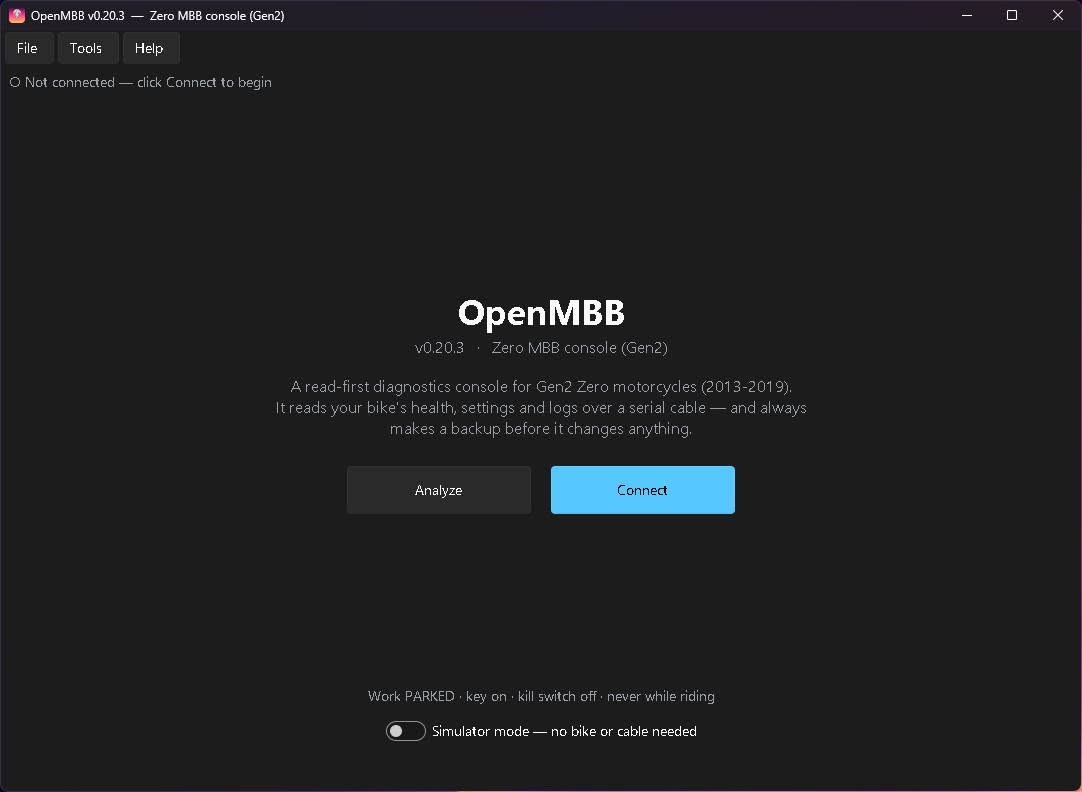
A free desktop app that reads a Gen2 Zero's own diagnostics over the service port — battery health, error logs, ride analysis — and ends in a plain verdict on the pack. Built-in simulator included.
Project Overview:
My 2017 Zero FXS will tell you almost everything about itself — battery management data, motor controller state, a complete error log — but the conversation happens over a service-port console that normally only dealer tools speak. The official Bluetooth app kept letting me down when what I wanted to know was how my battery was actually aging, so I decided the bike and I should talk directly. OpenMBB is the result: a free, open-source desktop app that connects to the bike's MBB (Main Bike Board) console, reads everything it will share, backs it up, and makes sense of it offline.
What It Does:
- Reads the bike's own diagnostics — identity, BMS and battery state, motor controller, lifetime stats, and the full error log — and saves clean backups of all of it.
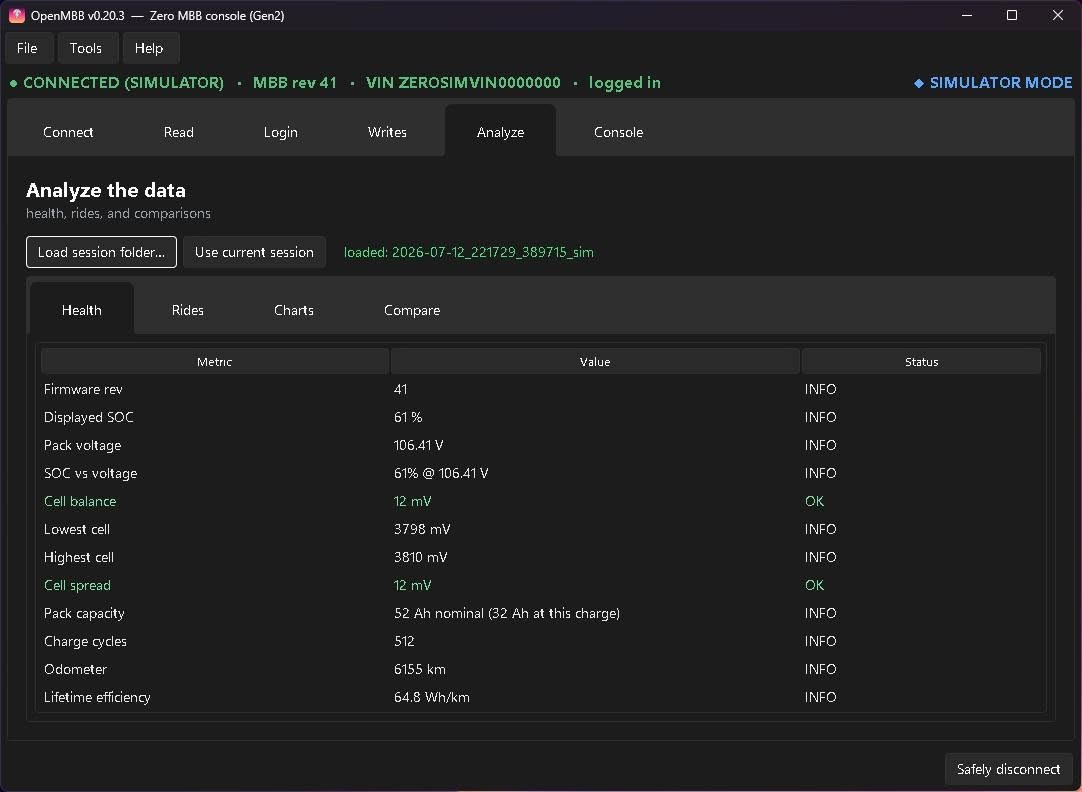
- Battery health analysis — cell voltages and balance, pack isolation, charge cycles, and capacity trends built from the bike's own data, so "how's the pack doing?" gets a real answer instead of a guess.
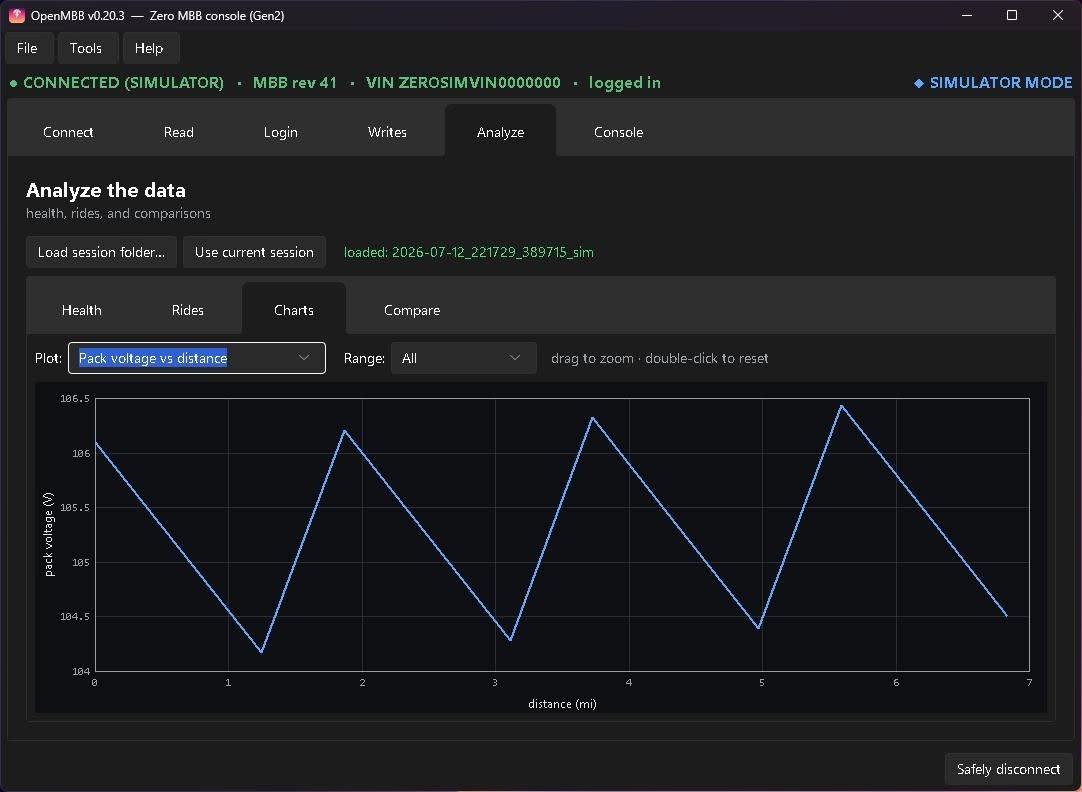
- Ride and gearing analysis — your ride history decoded from the bike's own event log, plus charts and sprocket math helpers.
- A plain verdict — the condition check answers what a buyer standing next to an unfamiliar bike actually wants to know: is this battery sound? It grades only what the capture can prove, says how many checks went unanswered rather than guessing, and saves a dated condition report. A guided Inspect-a-bike flow walks the whole visit — park it, test the cable, pull the data, read the verdict.
- A built-in simulator — the entire app works with no bike connected, so you can explore every screen before you ever plug in.
- Windows and Linux builds — a Windows installer, portable single-file binaries for both platforms, and source for anywhere Python runs. Continuous integration builds and verifies every release.
Safe by Design:
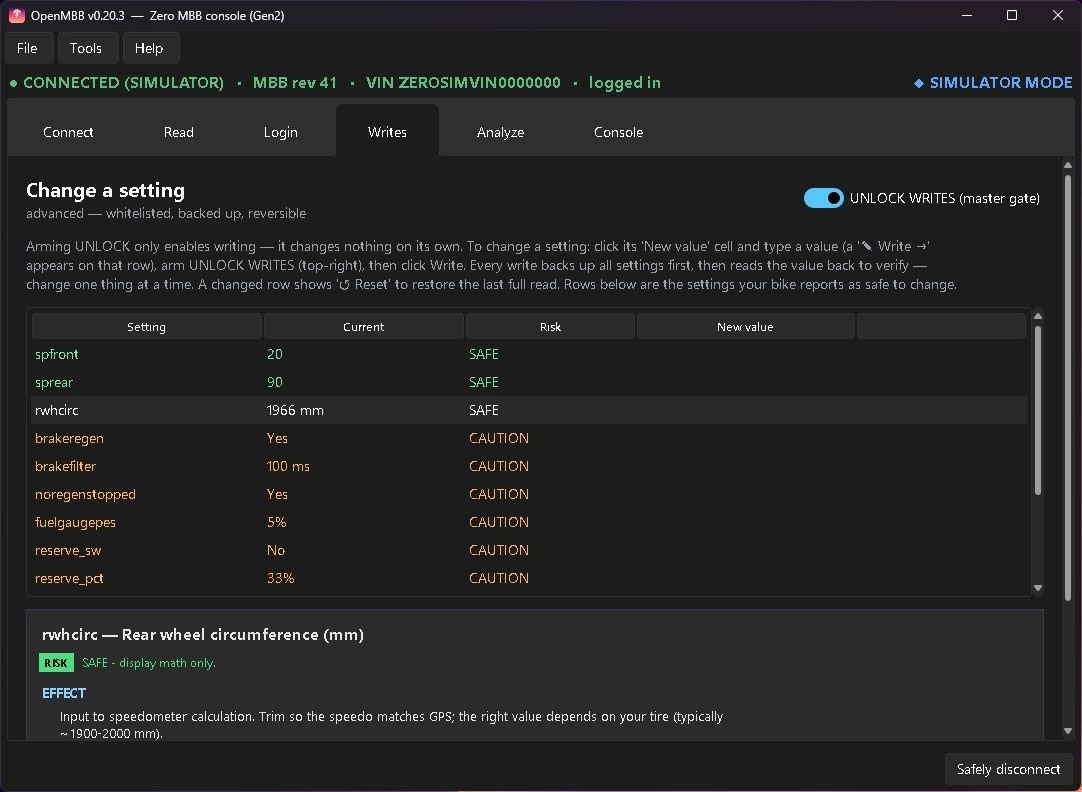
Tools that can write to a vehicle's brain deserve suspicion, so OpenMBB is read-first on purpose. Writing is off by default and limited to a whitelist; the Writes tab doubles as a reference of what's adjustable (sprocket/speedo trim, custom-mode speed, torque, and regen) — each setting shown with its effect and its risk — and any change is gated behind console login, a master unlock, and a per-write confirmation. Every write is journalled — what was asked, what the console answered, and what the bike actually held afterwards — because a tool like this should record what happened, not what it hoped for. It's an unofficial hobby tool, not affiliated with Zero Motorcycles, verified on my own 2017 FXS; other Gen2-era Zeros (roughly 2013–2019 S, SR, DS, DSR, FX, and the FXE) share the same console but are untested — so reads are the point, and writes are at your own risk.
Private by Construction:
OpenMBB makes no network requests — no telemetry, no update check, no crash reporting, no account. It has no HTTP client at all, and the test suite enforces that promise on every build. Your captures stay on your machine. If you ever want to share one, the share-safe export strips the VIN and serial numbers, re-scans everything it writes, and shows you every file line by line before anything leaves your hands.
The Hardware Side:
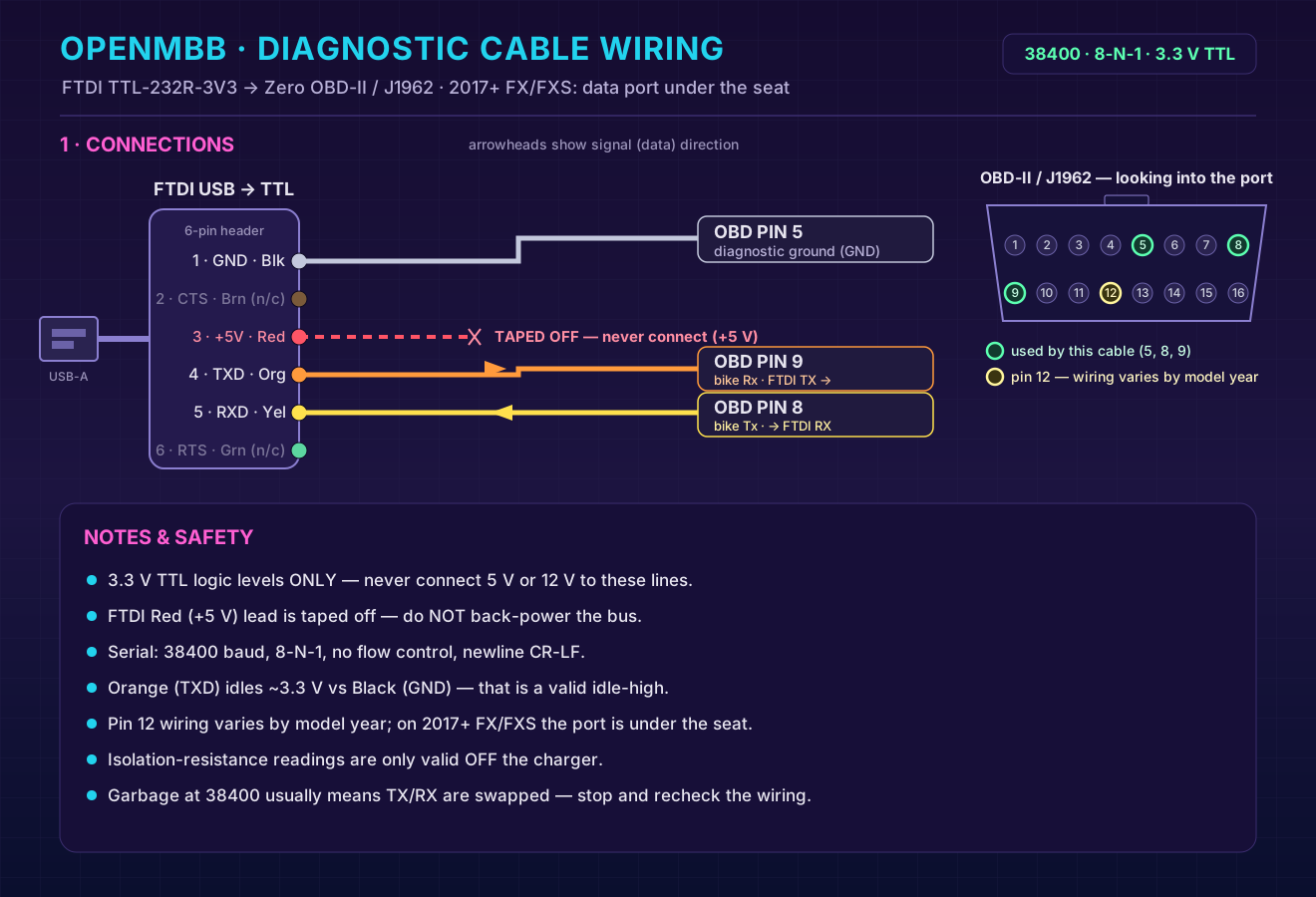
The whole interface is one inexpensive FTDI TTL-serial cable wired to the bike's OBD-II port — three pins and a ground. The app ships with the full wiring diagram, pinout, and the safety notes that matter (3.3 V logic only, never back-power the bus).
Get It:
OpenMBB is free and open source under the MIT license. The code, documentation, and ready-to-run downloads for Windows and Linux are all on GitHub.